 en
en العربية
  Türkçe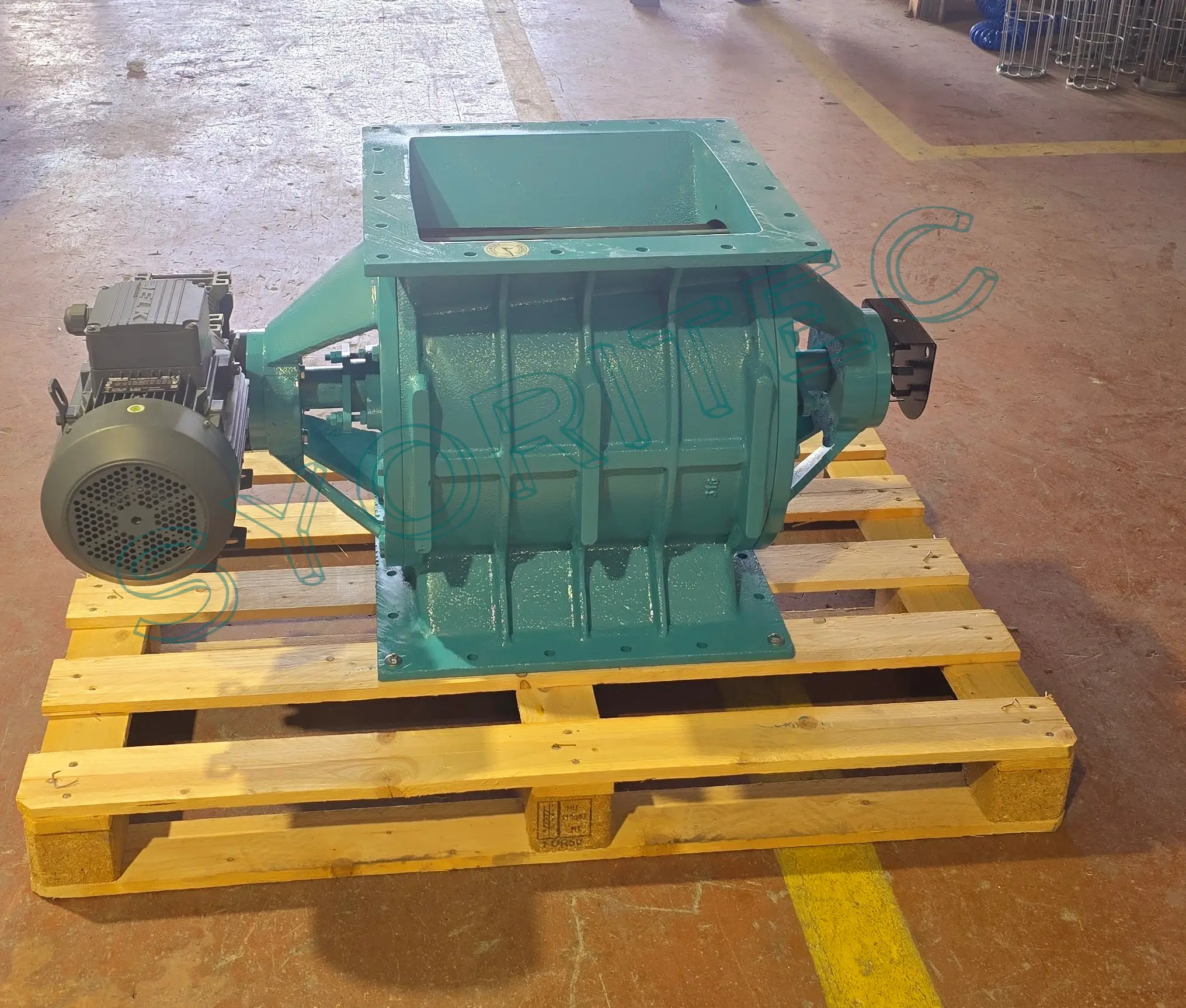
Cell Wheel | Rotary Valve | Air Lock
Airlock (Rotary Valve – Airlock – Rotary Feeder – Cell Wheel)
A Reliable Solution for Controlled Material Flow and Air Sealing in Industrial Processes
The airlock is one of the most critical components of pneumatic and mechanical conveying systems.
It enables the controlled, safe, and continuous transfer of powdered, granular, or pelletized materials between equipment such as silos, hoppers, cyclones, filters, mixers, conveyors, and dosing units—while simultaneously preventing air leakage between different pressure zones.
In industrial environments, this equipment is also known as:
Rotary Valve, Rotary Feeder, Airlock, Cell Wheel, Star Feeder, Rotary Vane Feeder, Eclus, Airlock Valve,
all referring to the same working principle and mechanical structure.
Engineering Definition of an Airlock
An airlock is a mechanical rotary valve equipped with a multi-pocket rotor that transfers material from an upper chamber to a lower chamber.
Each rotor cell carries a fixed volume of material while maintaining air-tight separation between the inlet and outlet sides.
This design fulfills two essential functions in modern processing lines:
1. Ensuring stable and continuous material flow
2. Preventing air transfer and maintaining pressure balance
For this reason, the airlock is indispensable in feeding, discharging, dosing, filtration, pneumatic conveying, and process stabilization applications.
Key Advantages of the Airlock (Rotary Valve)
- High sealing performance
Prevents air leakage between different process zones, improves the efficiency of pneumatic conveying lines, reduces energy losses, and stabilizes system pressure.
- Consistent and controlled material feeding
Ensures smooth, uniform transfer of powders and granular materials.
- Robust and durable construction
Cast-iron or steel housing provides long service life under abrasive, high-temperature, or heavy-duty applications.
- Suitable for food, chemical, and pharmaceutical industries
Enables clean, hygienic, and contamination-free material handling.
- Modular design with wide model options
Customizable rotor types, seal types, cell sizes, materials, and flange designs offer complete flexibility for different industrial processes.
Structural Features of the Airlock
A rotary airlock generally consists of:
-
Body (Housing) – cast iron or steel, high-strength construction
-
Rotor – multi-pocket rotating element
-
Side covers – support the rotor shaft
-
Bearings – mounted away from dusty zones for extended life
-
Sealing system – seals, gaskets, or air-purge sealing
-
Motor and gearbox – direct drive, coupling drive, or chain-sprocket drive
All components are manufactured with tight engineering tolerances to ensure:
-
No contact between rotor and housing
-
Reduced friction
-
Minimal air leakage
-
Low vibration and noise
-
Optimal energy efficiency
Working Principle
-
Material flows by gravity into the rotor pockets from the upper chamber.
-
As the rotor turns, each pocket fills with a measured volume of material.
-
The rotor carries the material downward toward the outlet.
-
Material is discharged continuously while air transfer is prevented.
-
The system operates smoothly and reliably without pressure loss.
This makes airlocks ideal for positive pressure, negative pressure, and gravity-flow conveying systems.
Applications
Pneumatic Conveying Systems
Transfer of powders, granules, and pellets such as cement, PVC, calcite, starch, sugar, ash, flour, fertilizers, feed pellets, and chemicals.
Filter and Cyclone Discharge
Maintains pressure balance and improves filtration efficiency.
Silo and Hopper Discharge
Ensures controlled and continuous material flow.
Food and Pharmaceutical Industries
Provides hygienic and contamination-free handling for sensitive products.
Plastics and Chemical Processing
Used for feeding, dosing, and transferring raw materials into production lines.
Criteria for Selecting the Right Model
Airlock selection depends on:
-
Material type: powder, granular, abrasive, fibrous, hot, sticky
-
Operating temperature and humidity
-
Pressure differential
-
Required throughput
-
Rotor type and pocket volume
-
Seal type (double seal, air-purge, mechanical seal)
-
Housing material (cast iron, stainless steel, Hardox)
Correct selection ensures higher system efficiency, lower maintenance, and long-term operational stability.
Conclusion
The airlock (Rotary Valve – Airlock – Cell Wheel) is a vital component in industrial processes, responsible for:
-
Regulating material flow
-
Maintaining pressure balance
-
Preventing air leakage
-
Increasing pneumatic conveying efficiency
-
Reducing energy consumption
-
Ensuring reliable 24/7 operation
With proper engineering, precision manufacturing, and the right model selection, an airlock provides a reliable, efficient, and long-lasting solution for any industrial production line.